
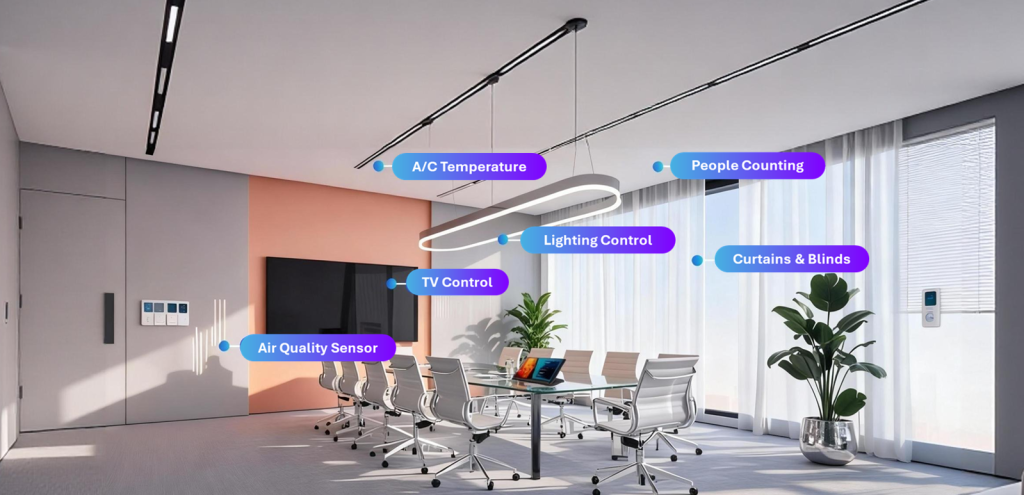
In today’s hybrid, fast-moving workplaces, audio visual systems ( AV systems ) are the backbone of effective collaboration. Whether you’re running town halls, board meetings, training, or daily stand ups, the difference between a smooth, automated AV experience and a manual, fragmented setup is the difference between productive teams and wasted time. This guide explains what an Audio Visual Control System is, why AV over IP (AVoIP) is replacing legacy architectures, and how an integrated platform like ESI-Tik delivers one touch meetings, centralized management, and zero downtime across the modern smart office.
What Is a Modern Audio Visual Control System?
At its core, an Audio Visual Control System functions as the central intelligence for your meeting rooms, training facilities, and collaborative spaces. Think of it as the unified command center that connects and orchestrates every piece of technology in the room—from core AV System components like displays, cameras, microphones, and speakers to environmental controls such as lighting, HVAC, and blinds.
Gone are the days of juggling multiple remotes and apps. A modern platform seamlessly integrates these disparate devices—including room scheduling panels and building management systems—into a single, intuitive interface. This unification is what transforms a collection of hardware into a cohesive, intelligent Audio Visual System.
In the context of a networked, smart office, this control foundation is crucial. By adopting an AV over IP architecture, where signals are distributed via the standard data network, the control system gains unprecedented scalability and central management capability. This enables consistent user experiences across all locations, simplifies IT and facilities management, and provides the foundation for data-driven optimization, automation, and significant energy savings.
Why Traditional AV Systems Struggle in the Modern Workplace
The legacy Audio Visual System, built on proprietary “box-based” hardware, is increasingly misaligned with the demands of dynamic, hybrid-first organizations. As we look at the workplace of 2026, the inherent limitations of these traditional setups create significant operational friction, cost overruns, and user frustration, highlighting an urgent need for technological evolution.
Traditional AV Systems: Inflexible Infrastructure and Scalability Costs
A traditional AV System is fundamentally constrained by its hardware-bound design. Video and audio routing depend on fixed matrix switchers with a limited number of inputs and outputs. Scaling this Audio Visual System—whether adding a new room or a new source type—requires installing larger matrices, pulling extensive new cables, and complex physical reconfiguration. This process is not only time-consuming and disruptive but leads to exponentially higher costs and a tangled, unsustainable infrastructure.
Traditional AV Systems: Limited Visibility and Manual Workflows
Legacy systems offer little to no end-to-end visibility into device status or signal health. Troubleshooting often becomes a time-consuming game of guesswork, leading to prolonged downtime during critical meetings. Furthermore, these systems burden users with overly complex, manual workflows. Operating a room typically involves juggling multiple remotes, physical switches, and disparate apps just to start a meeting—a poor experience that stifles productivity and adoption.
Traditional AV Systems: Fragmentation in the Hybrid Collaboration Era
The rise of standardized hybrid platforms like Microsoft Teams Rooms and Zoom Rooms has made the fragmentation of a traditional AV System glaringly obvious. Users universally expect a reliable, one-touch join experience, not a complicated procedure requiring technical assistance. The disconnect between the room’s hardware and the cloud-based collaboration software creates a brittle, unreliable meeting environment.
The smarter, future-proof path is a fundamental architectural shift: AV over IP. This approach replaces rigid, physical signal paths with flexible, software-defined routing that runs on a standard IP network. This evolution turns a stagnant AV System into a scalable, manageable, and intelligent asset perfectly suited for the next decade of work.
Why AV over IP Is Becoming the New Standard for Enterprise AV
The limitations of traditional hardware-centric designs have paved the way for a fundamental architectural shift. AV over IP (Audio Visual over Internet Protocol) is rapidly establishing itself as the new baseline for enterprise-grade Audio Visual System deployment. By distributing audio, video, and control signals as data packets across a standard network infrastructure, AV over IP delivers the scalability, manageability, and integration capabilities that modern organizations require.
AV over IP: Unmatched Scalability and a Future-Proof Investment
Unlike a traditional AV System locked into a fixed matrix switch, an AV over IP solution adopts a distributed, node-based approach. You simply add encoders (transmitters) and decoders (receivers) as needed, leveraging your existing IP network switches. This transforms scalability from a costly, disruptive project into a seamless, modular process. Expanding from three rooms to thirty, or connecting countless devices, becomes a matter of network capacity, not hardware replacement. This “pay-as-you-grow” model protects capital investment and simplifies future expansion, making your AV System inherently adaptable.
AV over IP: Centralized Management and Operational Intelligence
Because an AV over IP platform sits on your corporate IP backbone, it enables true centralized oversight. IT and AV teams can monitor the status, performance, and security of every connected device in multi locations from a single Portal, regardless of physical location. This end-to-end visibility is critical for enterprise operations, enabling proactive maintenance, rapid troubleshooting, and streamlined system-wide updates. This centralized control layer is what turns a network of devices into an intelligently managed Audio Visual System.
AV over IP: Seamless User Experience and Native Automation
The true power of AV over IP is realized when combined with a modern control system. This integration allows for the automation of complex workflows. With one touch on a panel or via a scheduling system, you can automate room setups: launching a video conference with zero perceived latency, while simultaneously coordinating the AV System, adjusting lighting, and setting the HVAC to a preset comfort level. This creates a consistent, intuitive user experience that requires no technical expertise, directly addressing the core demand for frictionless collaboration in the hybrid work era.
In summary, AV over IP is not merely an alternative signal routing method; it is the enabling architecture for a scalable, manageable, and intelligent Audio Visual System that meets the demands of today’s dynamic enterprise environment.
Traditional AV System vs. AV over IP Control
| Capability | Traditional AV System | ESI‑Tik AV over IP Control System |
| Scalability | Bound by matrix size and cabling | Add transmitters/receivers/IP switches as you grow |
| Reliability | Single points of failure | High Availability + Load Balancing; Zero Downtime |
| User Experience | Multiple remotes/apps | One‑touch unified control (5‑in‑1) |
| Automation | Limited scene control | AI‑powered profiles + full room automation |
| Management | Siloed, manual | Centralized IoT monitoring & control |
| ESG/Energy | Reactive | Energy Management &Optimization |
Meet ESI-Tik: The Modern AV over IP Control System Built for Smart Offices
Navigating the complexity of today’s hybrid workplace requires more than isolated technology—it demands a unified, intelligent command center. ESI-Tik is ESI Asia’s definitive answer: a next-generation Audio Visual Control System built on a robust AV over IP foundation. This platform is engineered to seamlessly converge audio, video, environmental controls, and room scheduling into a single, intelligent interface, transforming any meeting space into a smart office asset.
Designed for simplicity and power, ESI-Tik automates complete room setups for Microsoft Teams, Zoom, and Webex, ensuring cameras, audio, displays, lighting, and climate are perfectly configured the moment a meeting begins. Its intuitive interface guarantees one-touch operation, demystifying even the most advanced AV System and putting flawless collaboration within everyone’s reach.
What Sets ESI-Tik Audio Visual Control System Apart: Enterprise-Grade Capabilities
ESI-Tik distinguishes itself by bundling the essential, future-proof capabilities that modern enterprises require into one integrated Audio Visual Control System.
- One-Touch Meeting Automation: Eliminate meeting start-up friction. A single action joins a hybrid call, automatically activating and optimizing all displays, cameras, audio, and environmental settings for a professional, immediate start.
- Unified 5-in-1 Control Panel: Consolidate control into one intuitive interface. Manage lighting, the AV System, room scheduling, climate, and curtains from a single panel—ending the inefficiency of multiple remotes and disjointed apps.
- Zero Downtime with High Availability: Ensure business continuity with an active-active/N+N design. This architecture maintains seamless operation during maintenance or unexpected failures, guaranteeing that crucial meetings are never disrupted.
- AI-Powered Human Profile: Move beyond static presets. The system intelligently adapts to individual user preferences and real-time room context, delivering a personalized and responsive meeting experience.
- IoT Centralized Management: Gain command of your entire smart office from a single portal. Monitor, manage, and control all connected IoT and AV over IP devices in real-time across your portfolio for unparalleled operational oversight.
- Integrated Energy Management: Drive sustainability goals. Intelligent automation reduces power consumption by powering down unused equipment and optimizing environmental settings, directly supporting ESG compliance and reducing operational costs.
By integrating these capabilities, ESI-Tik transcends being a traditional Audio Visual Control System to become the central nervous system of a truly intelligent, efficient, and user-centric workplace.
How ESI-Tik Enhances the Modern Meeting Experience
A superior AV over IP control System (AVoIP) should be invisible in its operation, empowering people to connect and collaborate without technical barriers. ESI-Tik is designed with this principle at its core, transforming the meeting journey from a series of manual tasks into an intuitive, automated, and highly effective experience for every user and administrator.
Frictionless One-Touch Mee tings
ESI-Tik eliminates the clumsy start-up ritual that plagues traditional conference rooms. With One-Touch Meetings, the system intelligently automates the entire setup for platforms like Teams, Zoom, Webex or Google Meet. A single action powers on displays, selects correct inputs, activates optimized microphone and camera presets, adjusts environmental lighting, and joins the call—all with a seamless, zero-latency feel. This “no-expert-required” design dramatically reduces user friction and simultaneously lowers the volume of routine IT support tickets.
Consistent Unified Control
Complexity is the enemy of adoption. ESI-Tik’s Unified Control philosophy consolidates management of the AV System, lighting, scheduling, climate, and shades into one intuitive interface. This standardization is ideal for deploying a consistent user experience (UX) across hundreds of rooms and multiple regions. Administrators can use centralized templates and policies to ensure every space behaves identically, simplifying training and boosting user confidence enterprise-wide.
Intelligent Personalization
Moving beyond one-size-fits-all settings, ESI-Tik’s AI-Powered Human Profile introduces context-aware intelligence. The system can recognize user roles or meeting types, automatically adapting room configurations to suit a brainstorming session differently than a board review. This personalized approach, powered by the underlying AV over IP data flow, improves comfort and engagement for both presenters and attendees by tailoring the environment to the task at hand.
Proactive Centralized Oversight
For operations teams, visibility is control. ESI-Tik provides Centralized Oversight through a single dashboard, offering real-time status of every device in the Audio Visual System. Facilities and IT teams can perform remote diagnostics, push updates, and manage configurations without setting foot in a room. This capability significantly increases system uptime and reduces costly on-site visits, ensuring the technology infrastructure is always meeting-ready.
Automated Sustainability
True modern design incorporates responsibility. ESI-Tik’s Energy Management System ensures that efficiency is not an afterthought. By automatically powering down unused equipment and optimizing HVAC and lighting based on occupancy and scheduling data from the AV System, it actively reduces energy consumption. This intelligent automation provides measurable data and direct utility savings, helping organizations advance their ESG targets without requiring additional, standalone tools.
In essence, ESI-Tik redefines the meeting experience by ensuring the sophisticated AV over IP technology works silently in the background, prioritizing human connection, operational simplicity, and corporate responsibility.
Who Benefits Most from a Modern Audio Visual Control System?
A modern, unified Audio Visual Control System is not a one-size-fits-all solution, but rather a strategic platform that solves critical, industry-specific challenges. By moving beyond fragmented hardware to an integrated, often AV over IP-based approach, organizations across sectors can achieve new levels of operational efficiency, user satisfaction, and strategic value from their technology investments.
Corporate Enterprises & Global Organizations
For multinational corporations, consistency and manageability are paramount. A modern Audio Visual System enables the standardization of hybrid meeting experiences across all offices, countries, and time zones. This ensures that every employee, regardless of location, enjoys the same intuitive, one-touch meeting join experience, fostering seamless collaboration and reducing training and support overhead on a global scale.
Financial, Legal & Professional Services Firms
In client-facing and high-stakes environments, reliability is non-negotiable. These sectors benefit immensely from the high-availability (HA) and zero-downtime architecture of a platform like ESI-Tik. Ensuring flawless executive briefings, secure board meetings, and impressive client presentations without technical risk protects reputation and enables business continuity, making the Audio Visual Control System a mission-critical investment.
Education, University & Corporate Training Facilities
Flexibility and scalability define these dynamic spaces. The inherent AV over IP foundation of a modern system allows rooms to be reconfigured software—not hardware—for lectures, group work, or presentations. This scalability simplifies expansion across campuses and supports diverse pedagogical needs, all while providing central IT teams with the tools to manage extensive technology fleets efficiently.
Government, Defense & Public Sector Entities
Resilience, security, and centralized oversight are fundamental requirements. A modern Audio Visual Control System provides robust, secure signal distribution and meets stringent compliance standards. Crucially, it offers centralized monitoring and control, allowing administrators to maintain system integrity, manage secure spaces, and ensure operational readiness across dispersed facilities from a single, secure command point.
Smart Office Developers & Forward-Thinking Enterprises
For organizations prioritizing sustainability and operational intelligence, the Audio Visual System is the integration point for building automation. It enables occupancy-driven control of AV, lighting, and climate, directly reducing energy waste. This integrated data stream is vital for accurate ESG reporting and creating automated, efficient, and responsive work environments that align with corporate responsibility goals.
In each case, the transition to a modern Audio Visual Control System and AV over IP infrastructure transforms a cost center into a strategic asset that directly supports core operational and business objectives.