
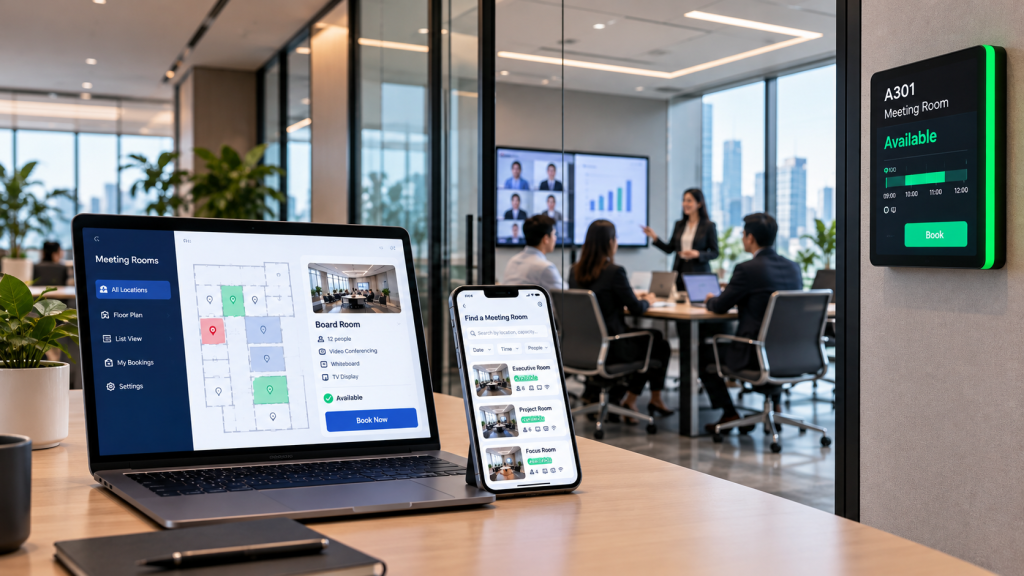
Meeting rooms in banking, finance and insurance carry more weight than in most industries. They host client reviews, credit committees, claims discussions and board meetings where confidentiality and punctuality all matter. Yet many Hong Kong firms still rely on shared calendars, paper visitor logs and control panels that need a technician to operate. Smart meeting rooms change that by connecting booking, visitor access, AV control and building data into one system. This guide explains what smart meeting rooms mean for BFSI firms in Hong Kong and how to plan a rollout.
Why Meeting Rooms Matter More in Banking, Finance and Insurance
For a retail business, a meeting room is a place to talk. For a bank, an asset manager or an insurer, it is often where regulated activity happens. Relationship managers meet high net worth clients. Underwriters review risk with brokers. Compliance teams interview staff. Each of these meetings involves sensitive information and, often, people from outside the organisation.
That raises the stakes on details that seem small elsewhere:
- A double booked room means a client waits in reception, which reflects poorly on the brand
- An unescorted visitor in the wrong zone becomes a security and privacy concern
- A video call that takes ten minutes to start wastes senior time across several offices
- A room left with lights and air conditioning running overnight adds to energy costs and ESG reporting gaps
Hong Kong adds its own pressures. Office space in Central, Admiralty and Quarry Bay is among the most expensive in the world, so every underused room has a real cost. Financial firms also tend to run hybrid teams across Hong Kong, mainland China and Southeast Asia, which means most meetings now mix in room and remote participants.
The Pressures Facing BFSI Workplaces in Hong Kong
Confidentiality and Data Protection
data in financial services Personal Data (Privacy) Ordinance, guidance from the HKMA, the SFC the Insurance Authority. Any system Workplace platforms should offer role based access, secure login and clear data handling.
ESI-TIK was built with this requirement at its core. ESI has achieved ISO/IEC 27001:2022 certification for the ESI-TIK smart workplace platform, giving IT and risk teams an international benchmark to assess it against.
Compliance and Audit Trails
Regulators and internal audit teams increasingly expect firms to show who was on site, when and why. Paper visitor books and spreadsheets make that difficult. A digital visitor management system creates a searchable record of every guest, including pre registration, check in time, host and check out.
Hybrid Teams and Client Expectations
Clients of private banks and insurers expect a polished experience. That means a room that is ready on arrival, a screen that connects first time and a host who is notified the moment their guest arrives. Internal teams expect the same for cross border calls on Microsoft Teams or Zoom.
What Makes a Meeting Room Smart
A smart meeting room connects four layers that are usually managed separately: booking, access, in room technology and building data. When these layers share information, the room can prepare itself, record what happened and report on how it is used.
| Area | Traditional Meeting Room | Smart Meeting Room |
| Booking | Shared calendar or email to admin | AI booking with live availability and approval rules |
| Visitors | Paper log at reception | QR pre registration, printed badges, host alerts |
| Starting a meeting | Several remotes and a call to IT | One touch start with automatic room setup |
| Room settings | Same default for every user | Personal profiles recalled for each organiser |
| No shows | Room sits empty | Automatic release after a set time |
| Faults | Reported after a meeting fails | Real time monitoring and remote fixes |
| Energy and ESG | Estimated manually | Measured by room with ESG reports |
The difference that matters most is integration. A booking system on its own cannot set up a room, and an AV control panel on its own does not know who booked it. Value comes from connecting the two.
ESI-TIK is designed around that principle. Its booking platform passes the organiser’s details through to the AV control system, so the room knows who is arriving and what they need before anyone walks in.
Smart Meeting Room Features by BFSI Use Case
Different teams within a financial institution use meeting spaces in different ways. Mapping features to real use cases helps prioritise what to deploy first.
| BFSI Use Case | Key Need | Features That Help |
| Private banking client meetings | Discretion and a polished arrival | Visitor pre registration, wayfinding, host notifications |
| Executive and board meetings | Booking control for senior staff | Delegate booking by assistants, approval based booking |
| Claims and underwriting reviews | Frequent short sessions | Mobile booking, no show auto release |
| Cross border team calls | Fast, reliable video | Teams, Outlook and Zoom integration, one touch start |
| Branch and regional offices | Consistent standards at every site | Multi location management, central dashboards |
| Facilities and ESG teams | Accurate usage and energy data | Occupancy sensors, energy monitoring, ESG reports |
Booking That Fits How Finance Teams Work
Senior bankers rarely book their own rooms. Executive assistants do it for them, often under time pressure. Delegate booking lets assistants schedule on behalf of executives, while approval based booking protects boardrooms and client suites from casual use.
ESI-TIK adds an AI booking agent that accepts requests by voice or text through WhatsApp, in any language, and books both the room and the Teams meeting in one step. It also syncs with Outlook, Teams, Zoom and Webex, so staff can keep using the tools they already know. Our guide to AI room booking systems explains how this works in more detail.
In Room Experiences That Respect Senior Time
Most AV control systems run the same setup for everyone. A partner who always presents locally and a manager who always runs hybrid calls get identical default settings, then spend the first few minutes adjusting them.
The ESI-TIK AI Powered Human Profile takes a different approach. It identifies the meeting organiser, recalls the lighting, display, blinds and air conditioning settings they used last time in that room, and restores them automatically. This only works because booking and AV control are connected, which is why the feature is rare in the market.
How to Plan a Smart Meeting Room Rollout
A phased approach reduces risk and lets you prove value to stakeholders before scaling across floors or branches.
- Audit current rooms. Record room sizes, existing AV equipment, booking methods and common complaints from staff and clients.
- Involve IT security and compliance early. Share data flows, certifications and access controls before procurement, not after.
- Prioritise high impact spaces. Start with client meeting suites and boardrooms, where the experience gap is most visible.
- Integrate with existing collaboration tools. Confirm support for Microsoft Teams, Outlook, Zoom or whichever platforms your firm has standardised on.
- Connect visitor management to booking. Guests should receive a QR code automatically once a meeting is confirmed.
- Add monitoring and energy data. Centralised device monitoring and occupancy sensors turn rooms into a source of facilities and ESG insight.
- Review usage after 90 days. Use booking trends and no show data to resize, repurpose or add rooms.
Reliability deserves particular attention in finance, where a failed board call is not an option. ESI-TIK uses an N+1 high availability design with a self healing core, so room control continues even if a single component fails. Its IoT centralised management platform also lets support teams monitor device health and fix issues remotely across every floor and building.
For a closer look at how these capabilities apply to insurers specifically, see how ESI-TIK addresses common headaches in insurance operations
FAQs About Smart Meeting Rooms for Banking, Finance and Insurance
Can a smart meeting room system integrate with our existing AV hardware?
In many cases, yes. Most enterprise platforms work alongside common control and conferencing equipment, though older devices may need a gateway or replacement. A site survey is the best way to confirm what can be reused before budgeting.
How long does it take to deploy smart meeting rooms in a Hong Kong office?
A pilot covering a few rooms can often be completed within weeks, depending on cabling, hardware lead times and security review. A full rollout across multiple floors or branches is usually phased over several months to limit disruption.
Is it possible to see a smart meeting room before committing?
Yes. ESI runs an Experience Centre in Kwun Tong where teams can try one touch room automation, IoT centralised management, energy automation and certified Microsoft Teams and Zoom room devices in a working environment.
Do smart meeting rooms help with ESG reporting?
They can provide measurable data that manual tracking cannot. Occupancy sensors and energy monitoring show how much power each room uses and whether space is being used efficiently, which supports carbon reporting and real estate decisions.
Who should own a smart meeting room project in a financial institution?
Ownership usually sits with facilities or workplace teams, with IT, information security and compliance as key stakeholders. Involving all four from the start avoids delays during vendor assessment and makes adoption smoother.
Stay Connected with ESI
Never miss an ESI update! Subscribe to our newsletter by sharing your email address via WhatsApp.
Subscribe via WhatsApp