IoT Centralized Management for Smart Office Buildings
联系我们


Most workplaces already run dozens of connected devices: occupancy sensors, air quality monitors, room panels, lighting controllers, air conditioning zones and meeting room hardware. Very few run them from one place. IoT centralized management fixes that by pulling every connected asset into a single dashboard with live status, historical data and remote control. This guide explains how an IoT management system works, what separates a real IoT device management platform from a folder full of vendor apps, and how to evaluate one for a Hong Kong office portfolio.

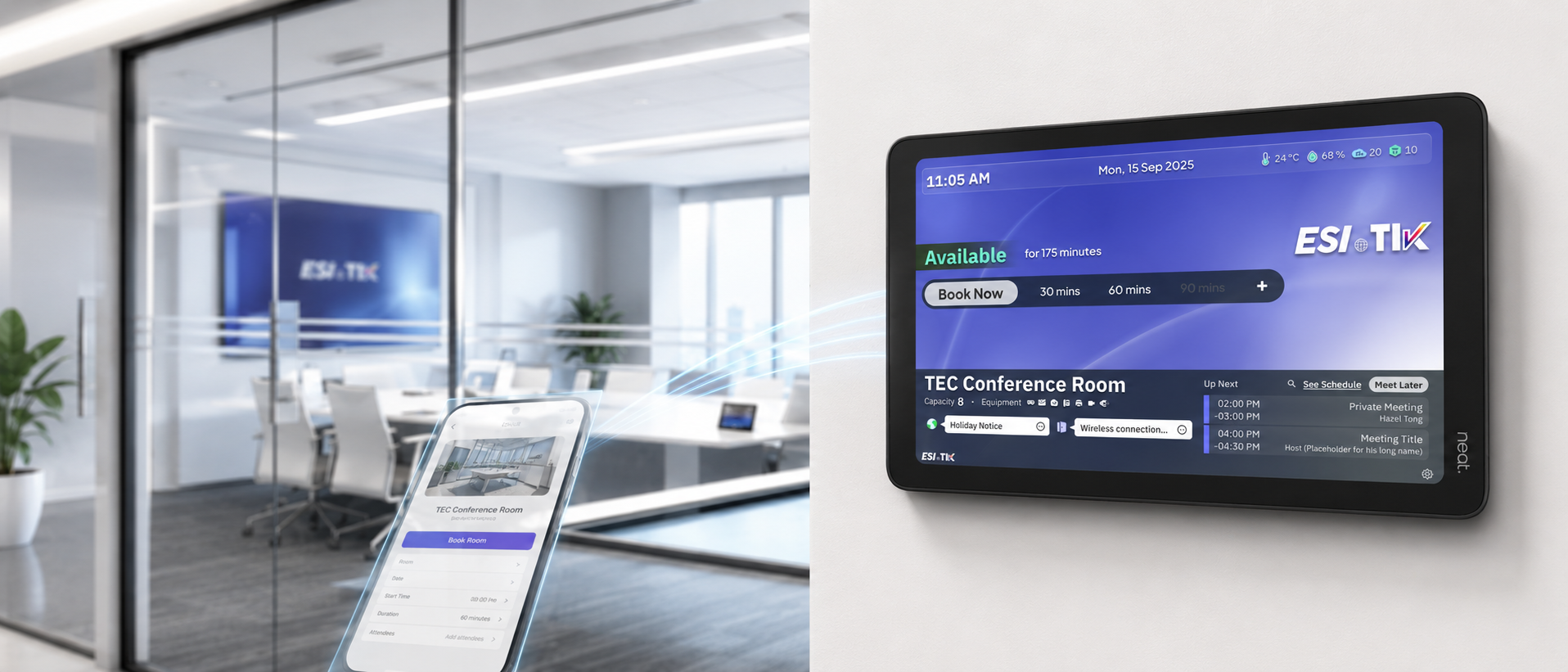
IoT centralized management is the practice of monitoring and controlling every connected device in a building, or across a portfolio of buildings, from one system rather than from each manufacturer’s own console.
A complete IoT system usually operates on four layers:
The last two layers are what separate an IoT monitoring platform from a genuine management platform. Monitoring tells you a display panel has dropped offline. Management lets you restart it from a desk on another floor.
ESI-TIK, the smart workplace platform built by ESI Asia, treats this as one of three linked pillars alongside room booking and AV control, which is why its device layer is designed to talk to the booking layer rather than sit beside it.
Most offices did not plan an IoT estate. It accumulated. Every fit out, refresh and pilot added another controller with its own app, login and support contact.
The result is predictable:
Each individual gap looks minor. Together they produce a workplace that is expensive to run and impossible to report on.

统一管理所有空间与设备,提升运营效率与安全性,实时掌握关键数据。
统一界面简化多地点、多空间的设备与房间管理。实时查看使用情况、设备状态与资源分配,提升效率与安全性。
View room occupancy, device health, and resource usage in a unified interface, ensuring you have a comprehensive overview of your facility’s status at all times.
无论身在何处,轻松操控 AV 系统、物联网设备与房间预订,为管理者带来更高的灵活性与便利性。
利用占用与空气质量传感器,自动调节灯光、窗帘与温度,打造舒适节能的智能空间。
深度分析空间使用、能耗与预订趋势,助您优化运营策略,实现智能决策。
实时追踪能源使用,优化碳足迹,通过可执行洞察推动可持续发展与成本节约。
Organisations generally land on one of three models. The right choice depends on how much of the estate is workplace technology rather than base building plant.
| Criteria | Standalone vendor consoles | Traditional building management system | Unified IoT device management system |
|---|---|---|---|
| Device scope | One brand or one category | Base building plant such as HVAC, power and fire | Any IP connected device, workplace and building |
| Visibility | Fragmented across logins | Strong on plant, weak on rooms | Single dashboard across rooms, floors and sites |
| Alerting | Per system, often email only | Engineering alarms for a control room | Condition based rules routed by team |
| Remote control | Varies by vendor | Plant level, rarely device level | Device level and group level |
| Room context | 无 | Limited | Linked to bookings, occupancy and AV state |
| Reporting | Manual export and merge | Energy and plant focused | Occupancy, energy, device health and ESG in one set |
| Best fit | Small single site estates | Landlords and base building operators | Multi floor and multi site corporate workplaces |
A building management system and an IoT management platform are not competitors so much as neighbours. The platform handles the workplace layer that the base building system was never designed to see.
Smart office IoT only becomes useful when device data crosses over into the systems people actually touch. A sensor that reports an empty room is data. A sensor that cancels the no show booking, releases the room to the pool and drops the air conditioning setpoint is automation.
That crossover is where most deployments fall short, because the booking system, the AV over IP 控制系统连接后 and the IoT layer are usually bought from three different suppliers. Without integration, each one only sees a slice of the room.
ESI Asia built ESI-TIK around exactly this junction. The IoT layer shares state with the booking engine and the room automation engine, so a single meeting start command can set lighting, displays, blinds and audio together, and the AI 个人化用户档案 can restore the organiser’s preferred room configuration automatically instead of forcing a fresh setup every time.
The same integration pays off in sustainability reporting. When occupancy data, environmental readings and consumption data come from one platform, energy automation and power monitoring produce ESG figures that stand up to audit rather than estimates assembled by hand each quarter.

Use these criteria when shortlisting vendors for a corporate estate:
Treat the pilot seriously. Two floors, mixed device brands and a full month of data will expose integration gaps that no proposal document reveals.
Watch: ESI Smart Office
For a wider view of how device management fits alongside room booking, visitor management and hot desking, see the 现代办公空间及设施管理 overview.
联系我们
实时监控空间与设备状态,快速发现并解决问题,保障设施稳定运行,减少停机时间。
随时随地控制 AV 系统、物联网设备与空间预订,提升管理灵活性,降低现场管理负担。
通过传感器自动调节灯光、窗帘与气候设置,根据占用与空气质量动态优化,打造节能舒适环境。
Advanced reporting and insights provide detailed analytics on room usage, energy consumption, and booking trends, enabling you to make data-driven decisions to optimize your facility’s operations.
预测性维护与自动告警机制,帮助您主动应对潜在问题,提升安全性,降低维护成本。
The platform’s real-time data visualization and centralized control give you a comprehensive overview of your facility’s status, allowing you to manage all connected devices seamlessly and efficiently.

In most cases yes. Any device that exposes an IP interface or a standard control protocol can usually be onboarded, including panels, sensors, displays and controllers already installed. Older serial only equipment may need a gateway. A site survey before contract signature will confirm exactly which assets carry over and which need replacing.
A single floor pilot typically runs in weeks rather than months, with the full rollout paced by device access and change windows. Deployment time is driven far more by physical access to rooms and network readiness than by the software itself. Platforms with configuration engines rather than custom programming cut commissioning effort dramatically.
Ask for a defined service level covering monitoring, remote intervention and on site attendance, with named escalation contacts. Ongoing IoT support should also include firmware management, periodic health reviews and lifecycle advice on ageing devices. Clarify whether support is delivered locally or routed offshore, since that dictates real response times.
A centralized platform is generally more secure than scattered consoles, because credentials, patching and access rights are managed in one place instead of being forgotten across a dozen logins. Look for role based access control, audit logging, network segmentation for device traffic and recognised certification of the vendor’s security management system.
Both, with one accountable owner. IT normally owns network, identity and security; facilities owns device operations, maintenance and space performance. The platform should support separate roles and dashboards for each function so neither team has to work through the other to get its job done.


